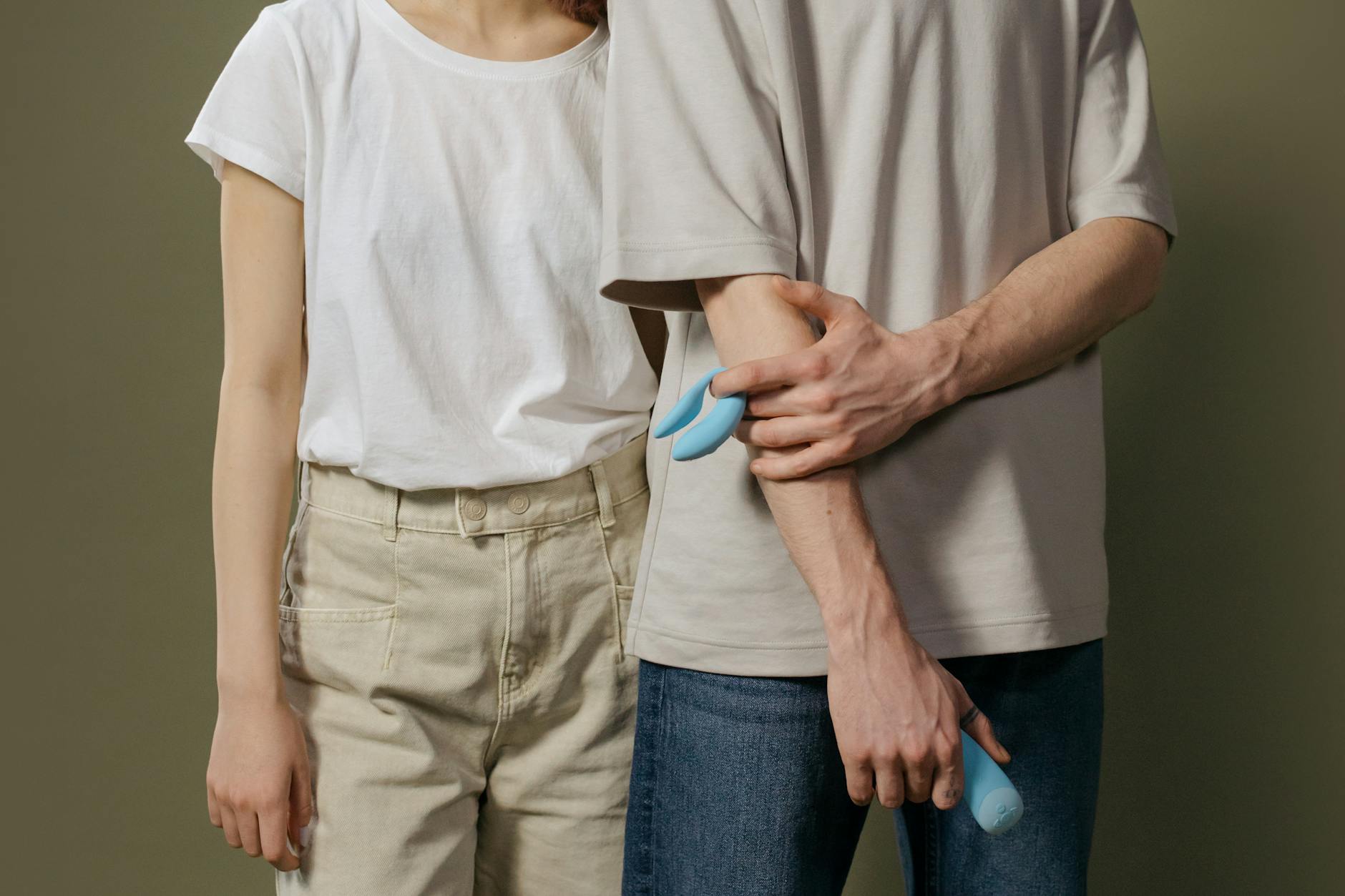
The gap between solo and partnered is real—and actually common
You know exactly how to get yourself there. You've mapped every pattern, speed, angle. Solo, it takes you 10 minutes with a lemon clitoral vibrator or your fingers. Then your partner gets involved and suddenly you're somewhere else entirely—tense, distracted, watching yourself from the outside. The harder you try, the further away the orgasm gets.
This isn't a reflection on your desire, your relationship, or your body. It's a pattern, and patterns can shift.
Why your nervous system locks down with someone watching
Here's what's happening neurologically. When you're alone, your brain can drop into a state where pleasure is the only signal. Your parasympathetic nervous system (the one that handles rest, digestion, arousal) is fully in charge. Orgasm requires that total absorption.
When a partner is present, your brain automatically switches into a monitoring mode. You become aware of their breathing, their gaze, the pressure to perform. This activates your sympathetic nervous system, the fight-or-flight branch. It doesn't matter that your partner is loving and safe. Your nervous system is running an old script: someone's watching, so stay alert.
That hypervigilance is incompatible with the kind of surrender orgasm requires. You can feel turned on. You can feel the buildup. But the release reflex gets blocked at a neurological level.
Practically every person I've worked with who faces this has said the same thing: "I feel like I'm performing instead of experiencing." That feeling is the sympathetic nervous system doing its job. It just chose the wrong moment.
The lemon vibrator advantage in a partnered context
A lemon clitoral vibrator, like the Lem, changes this equation in several specific ways.
First, it redirects attention. Instead of monitoring whether you're "doing it right" or your partner is getting bored, your brain focuses on the sensation itself. The suction and pulsing patterns of a lemon vibrator create a tactile experience intense enough to pull your attention back into your body. This is not distraction. It's redirection.
Second, it removes the pressure to reciprocate in real time. When your partner is inside you or using their fingers, there's an implicit rhythm negotiation happening. You're half-aware of their stamina, their comfort, their timing. A toy lets you focus purely on your own sensation and pace, while your partner can focus on connection or their own pleasure.
Third, the Lem specifically removes friction pressure. Many people who struggle with partnered orgasm report feeling too aware of physical touch itself—it can feel irritating or overstimulating rather than pleasurable. Air-suction technology like the lemon vibrator uses gentle suction instead of direct vibration, which feels less invasive and more sustainable for long sessions.
How to introduce the lemon vibrator into partnered sex
Start with conversation, not during sex. Pick a neutral moment to say something like: "I've noticed I get in my head when we have sex. I want to try something that might help me stay present. I'd love your help testing it out." Make it collaborative, not corrective.
Most partners feel relieved. They've probably noticed the pattern too and assumed it was something they did wrong.
Make the toy visible before you use it together. Let your partner hold it, turn it on, understand how it works. Demystification reduces the chance they feel like they're competing with an object.
Begin with it solo while they're present. This is a huge middle step most people skip. Use your lemon clitoral vibrator while your partner is in the room but not touching you. They might read, watch, or help manage the remote. This lets your nervous system practice being watched while you're in pleasure mode. It's bridging.
Once you've climaxed a few times this way, invite them into the touch. Your partner might stimulate you elsewhere, kiss your neck, hold you. The key is that you're not replacing their touch. You're adding a layer of sensation that keeps you grounded.
Communicate what you're experiencing. "Harder," "lighter," "just hold me," "talk to me," "don't say anything." Your partner doesn't have to guess. Your nervous system is learning that it's safe to be fully present with someone else in the room.
The emotional work underneath
There's often a deeper layer here, and it's worth acknowledging.
Many people grew up internalizing the message that their pleasure was something to hide or contain. You learned to come quietly, to not be a burden, to prioritize someone else's experience. That conditioning lives in your nervous system. Orgasm requires vulnerability. Vulnerability feels risky when you've been taught to protect yourself.
Some of the blocks around partnered orgasm aren't really about the sex itself. They're about trusting that your pleasure matters as much as your partner's. They're about believing you're worth the space and attention required for you to come.
This is where working with a coach or therapist can help, especially if you find yourself stuck even after trying the lemon vibrator route. The tool works. But sometimes the underlying belief system needs attention too.
Practical setup tips that actually help
Small environmental changes move the needle more than you'd expect.
Use the lemon vibrator with added lube. Water-based lube reduces friction and makes the suction feel smoother. It also signals to your nervous system that this is about sensation, not performance. The sensation becomes the main event.
Control the lights yourself. Some people climax better in near-darkness. Some need visibility to feel connected. Decide this in advance so you're not negotiating mid-session.
Set a boundary around time. Tell your partner: "Let's give this 15 minutes. If I'm not close by then, we'll pause and try something else." Removing the pressure to "eventually get there" actually makes it more likely you will.
Manage sound. If silence feels isolating, ask your partner to breathe audibly or play music. If talking breaks your focus, tell them. Consent goes both ways and includes your sensory preferences.
Start on a day when you're already aroused. Don't use this as a tool to spark arousal from zero. You're teaching your nervous system that partnered arousal and release can coexist. That's easier to learn when some baseline desire is already present.
When it's not just about the tool
The lemon vibrator helps. But if you've tried this approach a few times and still feel blocked, something else might be in the way.
Listen to what your body is actually telling you during those moments. Is it anxiety? Resentment? Numbness? A sense that your pleasure doesn't matter? Shame about needing a toy? All of these are real, and they're different to work with.
If it's anxiety, gradual exposure plus the tool usually works. If it's resentment, the real work is in the relationship conversation. If it's numbness, you might benefit from addressing medication side effects or past trauma. If it's shame, that's worth exploring with a therapist who specializes in sexuality.
The lemon clitoral vibrator is a genuinely helpful tool. But it works best when you're also willing to get curious about what's underneath the block. The tool opens the door. You're the one who walks through it.
FAQ
Will using a lemon vibrator with my partner make them feel replaced?
Not if you frame it right. Most partners actually feel relieved. They're often already aware that you're struggling and feel helpless. A toy gives them something concrete to do instead of wondering what's wrong. The key is treating it as collaborative—"let's try this together"—not secretive or defensive.
How long does it usually take to orgasm with a partner once you introduce a lemon vibrator?
There's no standard timeline. Some people climax the first time they combine the toy with partnered touch. Others need 5-10 sessions to feel comfortable enough. Your nervous system is learning new associations. Be patient with it. The learning is happening even if the orgasm hasn't yet.
Can I use a lemon vibrator if I'm on antidepressants that numb sensation?
Yes, and it often helps more than other toys. Many SSRIs dull sensation, but they especially affect the feeling of friction and pressure. Suction-based stimulation like a lemon clitoral vibrator bypasses that in ways traditional vibration sometimes doesn't. You may still need longer warmup time and more intensity, but the tool often works better in this context than expected.
What if my partner wants to use the lemon vibrator on me but I prefer doing it myself?
Trust that preference. Solo control is part of what makes this work. You control the speed, the pattern, the pressure. Your nervous system knows you're in charge. If your partner using it feels like loss of control, that's real information. Lots of couples find that the person using the toy keeps control while the partner provides other kinds of touch (kissing, caressing, speaking).
Is there a best pattern or setting on a lemon vibrator for partnered sex?
Generally, lower to medium intensity works better than racing to the strongest setting. You want sustained building, not immediate overstimulation. Many people find pulsing patterns easier than continuous vibration because they feel less monotonous during longer sessions. Experiment during solo time first so you know what works before bringing your partner in.
What if I climax easily alone but also can't finish with a partner, even with the lemon vibrator?
That signals something deeper might be at play—possibly grief or resentment about the relationship, trauma memory that gets triggered in partnered contexts, or a fundamental mismatch in how you and your partner approach intimacy. This is when talking to a sex-positive therapist becomes really valuable. The tool helps with mechanical blocks. Internal emotional blocks need different work.
Moving toward integration
Using a lemon vibrator with a partner is not a workaround. It's actually a form of intimacy education—you're teaching your nervous system that pleasure and connection can coexist. That you can be vulnerable and safe at the same time. That your satisfaction matters as much as theirs.
Start small. Be honest. Keep experimenting. Your body is smarter than your anxiety. Given the right conditions—and a tool that actually works—it'll figure out how to let go.